

Australia Commercial Real Estate Market 2026-2034 | Size, Share
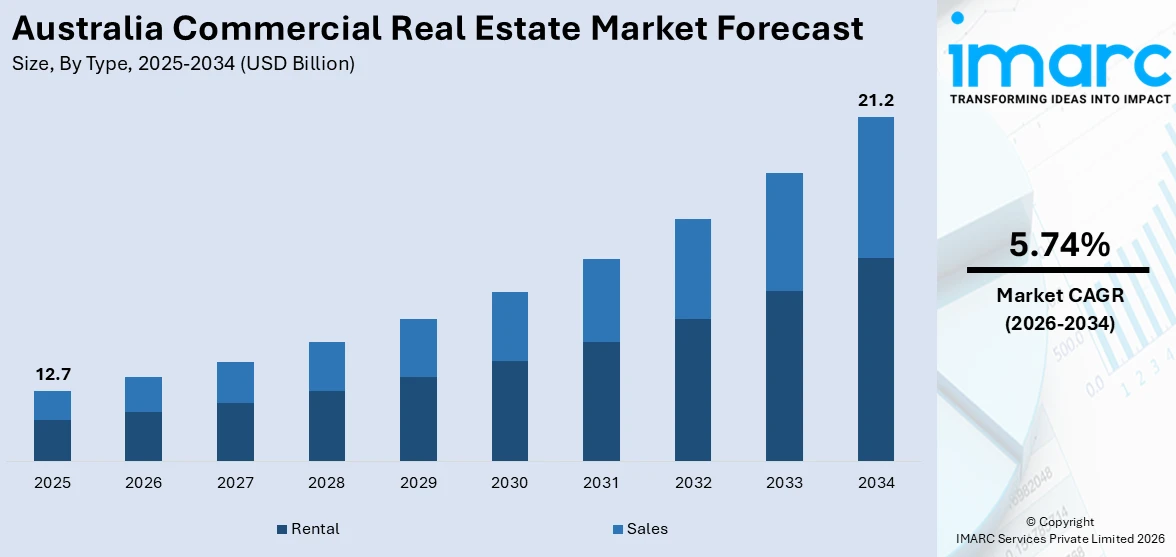
Australia commercial real estate market
Australia commercial real estate market size reached USD 12.7 Billion in 2025, is projected to reach USD 21.2 Billion by 2034, CAGR of 5.74% during 2026-2034
AUSTRALIA, May 12, 2026 /EINPresswire.com/ -- Australia Commercial Real Estate MarketComprehensive Market Analysis & Strategic Insights
Market Size: USD 12.7 Billion (2025) | Forecast: USD 21.2 Billion (2034) | CAGR: 5.74% (2026–2034)
𝗔𝘂𝘀𝘁𝗿𝗮𝗹𝗶𝗮 𝗖𝗼𝗺𝗺𝗲𝗿𝗰𝗶𝗮𝗹 𝗥𝗲𝗮𝗹 𝗘𝘀𝘁𝗮𝘁𝗲 𝗠𝗮𝗿𝗸𝗲𝘁 𝗢𝘃𝗲𝗿𝘃𝗶𝗲𝘄
The Australia commercial real estate market is entering a new phase of opportunity and structural transformation as the sector navigates evolving occupier demands, disciplined capital deployment, and accelerating sustainability requirements across office, industrial, retail, and leisure asset classes. The market is demonstrating resilient fundamentals with transaction volumes expected to grow 5–10% in 2026 and industrial property investment values projected to surpass office for the first time. With over 1,000 Green Building Council certified projects and 46% of CBD offices holding sustainability certifications, the sector is increasingly defined by quality bifurcation between premium ESG-compliant assets and struggling secondary stock.
𝐖𝐡𝐲 𝐈𝐬 𝐭𝐡𝐞 𝐀𝐮𝐬𝐭𝐫𝐚𝐥𝐢𝐚 𝐂𝐨𝐦𝐦𝐞𝐫𝐜𝐢𝐚𝐥 𝐑𝐞𝐚𝐥 𝐄𝐬𝐭𝐚𝐭𝐞 𝐌𝐚𝐫𝐤𝐞𝐭 𝐇𝐨𝐭 𝐓𝐨𝐝𝐚𝐲?
Australia's commercial property sector is commanding exceptional attention as structural tailwinds converge across industrial, office, and retail asset classes. Industrial investment volumes are reaching $6.7 billion in 2025 — well above long-term averages — with East Coast vacancy at just 3.2%. Brisbane's CBD is delivering the highest compound rental growth at 7.1% annually through 2030, outpacing Sydney and Melbourne. Perth's industrial vacancy is at a record-low 2% with AUKUS defence investment poised to double the sector's footprint by 2034. CoStar Group is agreeing to acquire Domain Holdings for AUD 3.0 billion, transforming Australia's commercial real estate digital infrastructure.
𝐌𝐚𝐫𝐤𝐞𝐭 𝐆𝐫𝐨𝐰𝐭𝐡 𝐓𝐫𝐚𝐣𝐞𝐜𝐭𝐨𝐫𝐲 𝐚𝐧𝐝 𝐒𝐭𝐫𝐚𝐭𝐞𝐠𝐢𝐜 𝐎𝐩𝐩𝐨𝐫𝐭𝐮𝐧𝐢𝐭𝐢𝐞𝐬
The Australia commercial real estate market is witnessing a powerful convergence of supply constraints, structural demand drivers, and emerging growth sectors that are creating compelling investment opportunities across the asset class spectrum. Data centres, cold storage, and advanced manufacturing are emerging as high-growth industrial sub-sectors. Office supply pipeline diminution is expected to drive vacancy lower and support accelerating effective rental growth through 2026–2028. Retail recovery is widening with improving conditions across more locations. PropTech adoption is accelerating with 37% of Australian real estate firms actively using AI and the $5 billion PropTech market continuing to expand.
Request a Business Sample Report for Procurement & Investment Evaluation:
https://www.imarcgroup.com/australia-commercial-real-estate-market/requestsample
𝐌𝐚𝐫𝐤𝐞𝐭 𝐆𝐫𝐨𝐰𝐭𝐡 𝐃𝐫𝐢𝐯𝐞𝐫𝐬
• Industrial and logistics sector strength with investment volumes reaching $6.7 billion in 2025, East Coast vacancy at 3.2%, and e-commerce expansion driving demand for larger warehouse and distribution facilities across major corridors.
• Office market resurgence led by prime CBD assets with Brisbane delivering 7.1% compound annual rental growth, supply pipeline diminishing, and vacancy expected to decline through 2026–2028 as no significant new supply enters the market.
• Emerging growth sectors including data centres, cold storage, and advanced manufacturing creating new demand pillars within industrial, with AUKUS defence investment poised to double Perth's industrial footprint by 2034.
• Sustainability certification becoming essential for premium asset positioning, with 46% of CBD offices holding green certifications and Green Building Council certifying over 1,000 projects covering 64 million square metres.
• Foreign and institutional investment diversification with capital sources broadening, strong offshore participation, and patient capital deployment targeting yield and long-term value across quality assets.
𝐋𝐚𝐭𝐞𝐬𝐭 𝐌𝐚𝐫𝐤𝐞𝐭 𝐍𝐞𝐰𝐬
• May 2025: CoStar Group agreed to acquire Domain Holdings for AUD 3.0 billion, significantly strengthening Australia's commercial real estate digital infrastructure and data analytics capabilities.
• Q1 2026: Office markets demonstrate growth across all major CBDs led by Sydney, Brisbane, and Adelaide, with premium-grade assets achieving strong leasing outcomes and rental acceleration expected through 2026–27.
• Q1 2026: CBRE's Pacific Real Estate Market Outlook confirms transaction volumes expected to grow 5–10% in 2026, with faster growth in the office sector as investor confidence returns.
• December 2025: Cushman & Wakefield's year-end commentary forecasts industrial vacancy to peak at 3.6% in H2 2026, still below the 4% long-term equilibrium, reinforcing structurally tight leasing conditions.
• 2025 Full Year: Industrial investment volumes reached $6.7 billion — well above long-term averages — with Perth recording the tightest market at just 2% vacancy nationally.
𝐀𝐮𝐬𝐭𝐫𝐚𝐥𝐢𝐚 𝐂𝐨𝐦𝐦𝐞𝐫𝐜𝐢𝐚𝐥 𝐑𝐞𝐚𝐥 𝐄𝐬𝐭𝐚𝐭𝐞 𝐌𝐚𝐫𝐤𝐞𝐭 𝐒𝐮𝐦𝐦𝐚𝐫𝐲
• Industrial and logistics property investment values are projected to surpass office property for the first time by 2026, driven by e-commerce expansion, larger facility construction, and structurally tight vacancy at 3.2% across the East Coast.
• Office market bifurcation is intensifying with premium ESG-compliant assets achieving strong leasing outcomes while secondary stock struggles, as national vacancy hovers at 14.6% but prime markets in Brisbane and Adelaide perform strongly.
• Brisbane's CBD is delivering the highest compound annual rental growth in Australia at 7.1% through 2030, outpacing Sydney (5.7%) and Melbourne (4.4%), driven by supply constraints and strong occupier demand.
• Perth's industrial market is the tightest nationally at 2% vacancy, with AUKUS defence-related investment positioned as a generational demand driver potentially doubling the sector's industrial footprint by 2034.
• Data centres, cold storage, and advanced manufacturing are emerging as high-growth industrial sub-sectors, with demand for local secure data infrastructure at all-time highs and supply unable to keep pace.
• Over 500,000 square metres of new office space is launching by 2026, but the subsequent supply pipeline diminution is expected to drive vacancy lower and support accelerating effective rental growth through 2028.
• Sustainability certification is becoming non-negotiable for institutional investment, with 46% of CBD offices holding green credentials and the Green Building Council certifying over 1,000 projects covering 64 million square metres.
• PropTech adoption is accelerating with 37% of Australian real estate firms actively using AI and machine learning, with the $5 billion PropTech market and over 350 active firms driving digital transformation.
𝐇𝐨𝐰 𝐀𝐈 𝐈𝐬 𝐑𝐞𝐬𝐡𝐚𝐩𝐢𝐧𝐠 𝐭𝐡𝐞 𝐀𝐮𝐬𝐭𝐫𝐚𝐥𝐢𝐚 𝐂𝐨𝐦𝐦𝐞𝐫𝐜𝐢𝐚𝐥 𝐑𝐞𝐚𝐥 𝐄𝐬𝐭𝐚𝐭𝐞 𝐌𝐚𝐫𝐤𝐞𝐭
Artificial intelligence is rapidly emerging as a transformative force across Australia's commercial real estate sector, fundamentally reshaping property valuation, building operations, tenant engagement, investment analysis, and sustainability performance — with approximately 37% of Australian real estate firms now actively using AI and machine learning tools in their daily operations.
• AI-driven predictive analytics platforms are enabling investors and fund managers to forecast property valuations, rental growth trajectories, and market cycle timing with significantly improved accuracy, leveraging machine learning models trained on transaction data, economic indicators, and demographic trends.
• Smart building management systems powered by AI are optimizing energy consumption, HVAC performance, and lighting systems in real-time, enabling commercial properties to achieve sustainability certifications while reducing operational costs by up to 30% across large-portfolio operations.
• AI-enabled tenant experience platforms are transforming occupier engagement through automated service requests, predictive maintenance alerts, space utilization analytics, and personalized building amenity recommendations that improve retention and justify premium rental positioning.
• Machine learning-powered lease analytics tools are enabling asset managers to identify upcoming vacancies, model renewal scenarios, optimize rental escalation strategies, and benchmark portfolios against market conditions across multiple Australian markets simultaneously.
• Computer vision and IoT-integrated building analytics are enabling real-time monitoring of space utilization, foot traffic patterns, and occupancy density across commercial properties, informing adaptive workspace design and flexible leasing strategies for hybrid work environments.
𝐌𝐚𝐫𝐤𝐞𝐭 𝐓𝐫𝐞𝐧𝐝𝐬 𝐚𝐧𝐝 𝐈𝐧𝐬𝐢𝐠𝐡𝐭𝐬
• Industrial and logistics assets are commanding record investment volumes of $6.7 billion in 2025 with structurally tight vacancy below 4%, as e-commerce expansion, data centre demand, and AUKUS defence investment create multiple secular growth drivers.
• Office market quality bifurcation is accelerating with premium ESG-certified assets achieving strong leasing outcomes and rental growth, while secondary stock faces elevated vacancy above 14% and declining tenant demand.
• Supply pipeline diminution across office markets is expected to drive vacancy lower and support effective rental growth acceleration through 2026–2028, with Brisbane, Adelaide, and Sydney's core markets leading the recovery.
• Data centres are emerging as the fastest-growing industrial sub-sector, with Melbourne among the fastest-growing Asia-Pacific cities for capacity and demand for local secure infrastructure at all-time highs.
• Sustainability credentials are becoming non-negotiable for institutional capital, with 46% of CBD offices holding green certifications and investors increasingly requiring NABERS and Green Star ratings for portfolio inclusion.
• PropTech transformation is accelerating with 37% of firms using AI, over 350 active PropTech companies, and the $5 billion market driving innovation in valuation, building management, and tenant engagement.
𝐌𝐚𝐫𝐤𝐞𝐭 𝐆𝐫𝐨𝐰𝐭𝐡 𝐃𝐫𝐢𝐯𝐞𝐫𝐬 — 𝐃𝐞𝐭𝐚𝐢𝐥𝐞𝐝 𝐀𝐧𝐚𝐥𝐲𝐬𝐢𝐬
𝐈𝐧𝐝𝐮𝐬𝐭𝐫𝐢𝐚𝐥 𝐒𝐭𝐫𝐞𝐧𝐠𝐭𝐡, 𝐒𝐮𝐩𝐩𝐥𝐲 𝐂𝐨𝐧𝐬𝐭𝐫𝐚𝐢𝐧𝐭𝐬, 𝐚𝐧𝐝 𝐄𝐦𝐞𝐫𝐠𝐢𝐧𝐠 𝐆𝐫𝐨𝐰𝐭𝐡 𝐒𝐞𝐜𝐭𝐨𝐫𝐬
Australia's commercial real estate market is being driven by structural demand tailwinds across industrial and logistics, with investment volumes reaching $6.7 billion and East Coast vacancy at just 3.2%. Data centres, cold storage, and advanced manufacturing are creating new demand pillars. AUKUS defence investment is positioning Perth for generational industrial expansion. Office supply pipeline diminution is expected to trigger rental acceleration as vacancy declines through 2026–2028 across Brisbane, Sydney, and Adelaide.
𝐒𝐮𝐬𝐭𝐚𝐢𝐧𝐚𝐛𝐢𝐥𝐢𝐭𝐲 𝐑𝐞𝐪𝐮𝐢𝐫𝐞𝐦𝐞𝐧𝐭𝐬, 𝐃𝐢𝐠𝐢𝐭𝐚𝐥 𝐓𝐫𝐚𝐧𝐬𝐟𝐨𝐫𝐦𝐚𝐭𝐢𝐨𝐧, 𝐚𝐧𝐝 𝐂𝐚𝐩𝐢𝐭𝐚𝐥 𝐃𝐢𝐯𝐞𝐫𝐬𝐢𝐟𝐢𝐜𝐚𝐭𝐢𝐨𝐧
Sustainability certification is becoming essential for premium asset positioning with 46% of CBD offices holding green credentials and institutional investors mandating ESG compliance. PropTech adoption is accelerating with 37% of firms using AI tools. Foreign and domestic capital sources are diversifying, with patient investors targeting quality assets offering durable income streams. The flight to quality continues as investors prioritize strong tenant profiles, low capex exposure, and sustainable income generation.
𝐊𝐞𝐲 𝐓𝐫𝐞𝐧𝐝𝐬 𝐒𝐡𝐚𝐩𝐢𝐧𝐠 𝐭𝐡𝐞 𝐀𝐮𝐬𝐭𝐫𝐚𝐥𝐢𝐚 𝐂𝐨𝐦𝐦𝐞𝐫𝐜𝐢𝐚𝐥 𝐑𝐞𝐚𝐥 𝐄𝐬𝐭𝐚𝐭𝐞 𝐌𝐚𝐫𝐤𝐞𝐭 𝐋𝐚𝐧𝐝𝐬𝐜𝐚𝐩𝐞 𝐈𝐧𝐜𝐥𝐮𝐝𝐞:
• Industrial property values surpassing office for the first time by 2026, driven by e-commerce logistics demand, structurally tight vacancy below 4%, and emerging data centre and defence-related growth sectors.
• Office market quality bifurcation intensifying between premium ESG-certified assets achieving rental growth and struggling secondary stock, with supply pipeline exhaustion expected to drive recovery through 2028.
• Brisbane emerging as Australia's rental growth leader at 7.1% CAGR through 2030, with Perth's 2% industrial vacancy and AUKUS defence demand creating the nation's tightest market conditions.
• Data centres, cold storage, and advanced manufacturing establishing new institutional-grade industrial sub-sectors as digital infrastructure demand reaches all-time highs across Asia-Pacific markets.
• Sustainability certification transitioning from competitive advantage to minimum requirement, with 46% CBD office certification and institutional investors mandating Green Star and NABERS ratings.
• PropTech and AI adoption transforming operations with 37% of firms using machine learning, smart buildings reducing costs 30%, and predictive analytics improving investment decision-making across portfolios.
• Hybrid work evolution stabilizing with flexible office concepts, suburban migration patterns, and adaptive reuse projects reshaping tenant requirements and landlord strategies across CBD and metropolitan markets.
𝐊𝐞𝐲 𝐀𝐬𝐩𝐞𝐜𝐭𝐬 𝐑𝐞𝐪𝐮𝐢𝐫𝐞𝐝 𝐟𝐨𝐫 𝐀𝐮𝐬𝐭𝐫𝐚𝐥𝐢𝐚 𝐂𝐨𝐦𝐦𝐞𝐫𝐜𝐢𝐚𝐥 𝐑𝐞𝐚𝐥 𝐄𝐬𝐭𝐚𝐭𝐞 𝐌𝐚𝐫𝐤𝐞𝐭
• Property type segmentation covering office, industrial/logistics, retail, leisure, data centres, and mixed-use developments with investment volumes, vacancy rates, and rental growth analysis.
• Transaction type analysis covering rental vs. sales markets with investment volume trends, cap rate movements, and capital sources (domestic, offshore, institutional, private) assessment.
• Regional demand distribution across ACT & NSW, Victoria & Tasmania, Queensland, NT & SA, and Western Australia with CBD-level vacancy, rental growth, and investment activity mapping.
• Industrial sub-sector analysis covering traditional warehousing, e-commerce logistics, cold storage, data centres, and advanced manufacturing with demand drivers and capacity projections.
• Office market quality bifurcation assessment covering premium vs. secondary grade performance, vacancy differentials, ESG certification impact, and hybrid work adaptation strategies.
• Sustainability and ESG analysis covering Green Building Council certifications, NABERS ratings, carbon neutrality targets, and the financial impact of green credentials on asset valuations.
• Competitive landscape assessment covering major REITs, institutional investors, developers, property managers, and PropTech platforms with market positioning and strategy benchmarking.
• Technology and PropTech trends analysis covering AI-powered valuation, smart building management, IoT integration, tenant experience platforms, and digital twin applications.
• Pricing dynamics analysis covering rental rates by asset class and grade, cap rate trends, incentive levels, and the supply-demand dynamics driving effective rent projections through 2034.
𝐌𝐚𝐫𝐤𝐞𝐭 𝐒𝐞𝐠𝐦𝐞𝐧𝐭𝐚𝐭𝐢𝐨𝐧
IMARC Group's research categorizes the Australia commercial real estate market as follows:
𝐁𝐲 𝐓𝐲𝐩𝐞
• Rental
• Sales
𝐁𝐲 𝐄𝐧𝐝 𝐔𝐬𝐞
• Offices
• Retail
• Leisure
• Others
𝐁𝐲 𝐑𝐞𝐠𝐢𝐨𝐧
• Australian Capital Territory & New South Wales
• Victoria & Tasmania
• Queensland
• Northern Territory & South Australia
• Western Australia
𝐊𝐞𝐲 𝐏𝐥𝐚𝐲𝐞𝐫𝐬
The competitive landscape of the Australia commercial real estate market features a moderately concentrated structure with established REITs, institutional investors, developers, and property managers competing across asset classes. Major market participants include Dexus, Mirvac Group, Stockland, GPT Group, Goodman Group, Charter Hall, Lendlease, Vicinity Centres, and Scentre Group. The industrial sector is led by Goodman Group and Charter Hall, while office portfolios are dominated by Dexus and Mirvac. CoStar Group's AUD 3.0 billion acquisition of Domain Holdings is transforming digital market infrastructure. Detailed profiles are provided within the full IMARC Group research report.
𝐑𝐞𝐜𝐞𝐧𝐭 𝐍𝐞𝐰𝐬 𝐚𝐧𝐝 𝐃𝐞𝐯𝐞𝐥𝐨𝐩𝐦𝐞𝐧𝐭𝐬
Q1 2026: CBRE's Pacific Real Estate Market Outlook confirms transaction volumes expected to grow 5–10% in 2026, with faster office sector growth as investor confidence strengthens and capital deployment accelerates.
Q1 2026: Office markets demonstrate growth across all major CBDs led by Sydney, Brisbane, and Adelaide, with rental growth expected to accelerate in 2026–27 as the supply pipeline diminishes.
January 2026: Cushman & Wakefield's Australian Commercial Real Estate Outlook forecasts industrial vacancy to peak at 3.6% in H2 2026, remaining below the 4% long-term equilibrium reinforcing tight leasing.
January 2026: REACH Australia announces the 2026 cohort of high-growth PropTech companies, highlighting continued innovation in AI-powered building management, sustainability analytics, and tenant experience platforms.
May 2025: CoStar Group agreed to acquire Domain Holdings for AUD 3.0 billion, significantly strengthening Australia's commercial real estate data analytics and digital infrastructure capabilities.
2025 Full Year: Industrial investment volumes reached $6.7 billion — well above long-term averages — with Perth recording the nation's tightest market at just 2% vacancy.
2025 Full Year: Western Sydney logistics hub near the Aerotropolis recorded 9.1% growth, while over 500,000 square metres of new office space launched nationally with no significant pipeline following.
July 2024: National office vacancy reached 14.6% with significant variation across markets — Brisbane at 9.5%, Sydney at 11.6%, and Melbourne at 18% — demonstrating quality and location bifurcation.
𝐂𝐮𝐬𝐭𝐨𝐦𝐢𝐳𝐚𝐭𝐢𝐨𝐧 𝐎𝐩𝐭𝐢𝐨𝐧𝐬 𝐀𝐯𝐚𝐢𝐥𝐚𝐛𝐥𝐞 𝐟𝐨𝐫 𝐀𝐮𝐬𝐭𝐫𝐚𝐥𝐢𝐚 𝐂𝐨𝐦𝐦𝐞𝐫𝐜𝐢𝐚𝐥 𝐑𝐞𝐚𝐥 𝐄𝐬𝐭𝐚𝐭𝐞 𝐌𝐚𝐫𝐤𝐞𝐭:
• Regional analysis by state/territory and CBD including Sydney, Melbourne, Brisbane, Perth, Adelaide, and Canberra with vacancy rates, rental growth, and investment volume breakdowns.
• Asset class segmentation covering office (premium, A-grade, secondary), industrial/logistics, retail (CBD, suburban, neighbourhood), leisure, data centres, and mixed-use developments.
• Transaction type analysis covering rental and sales markets with cap rate trends, investment volume tracking, capital source diversification, and deal size distribution.
• Industrial sub-sector deep-dive covering traditional warehousing, e-commerce logistics, cold storage, data centres, advanced manufacturing, and defence-related facilities.
Other Report by IMARC Group:
Australia Real Estate Market 2026-20234: https://www.imarcgroup.com/australia-real-estate-market
Australia Foreign Exchange Market 2026-2034: https://www.imarcgroup.com/australia-foreign-exchange-market
Australia Fintech Market 2026-2034: https://www.imarcgroup.com/australia-fintech-market
Australia Private Equity Market 2026-2034: https://www.imarcgroup.com/australia-private-equity-market
Australia Data Center Market 2024-2034: https://www.imarcgroup.com/australia-data-center-market
Elena Anderson
IMARC Services Private Limited
+1 201-971-6302
email us here
Legal Disclaimer:
EIN Presswire provides this news content "as is" without warranty of any kind. We do not accept any responsibility or liability for the accuracy, content, images, videos, licenses, completeness, legality, or reliability of the information contained in this article. If you have any complaints or copyright issues related to this article, kindly contact the author above.
